
Grand Rapids Busted Mugshots
Grand Rapids anchors Kent County as its seat and largest city. The 2020 Census put its population at 198,917. The Grand Rapids Police Department handles city arrests and holds the police-side paperwork. For a current custody question, start instead with the county's Inmate Lookup and its linked KCCF Web Jail Viewer. Kent County Correctional Facility books people for more than 30 law-enforcement agencies. So a GRPD arrest can still show up as a county booking record. KCCF processes people from across the region.
That split matters more than you might think. The jail viewer shows who is in custody now. Depending on its public settings, it may list a photo or charge details. GRPD, meanwhile, may hold the arrest report and incident notes that never reach a jail result. A name match alone proves little. Kent County warns that data shifts fast, and only a fingerprint comparison truly confirms identity.
Record boundary: a current KCCF result, a GRPD incident record, and a later court case each answer a different question. Someone can leave the jail viewer after release while the booking or police record still sits with the responsible records office.
Where Grand Rapids Busted Mugshots Appear
Grand Rapids publishes no routine booking-photo roster. The county viewer is the official route for custody questions. The city does offer an incident monitor and public records channels. Neither works as a daily arrest log, though. News outlets and private indexes sometimes surface an event or an older copy of a photo. Treat those as leads only. They come after official verification, and they cannot tell you who is in custody right now.
| Channel | Photo or record | Status | Best use |
|---|---|---|---|
| KCCF Booking Search | May show configured descriptive data, charges, and a mugshot image | Official county source | Search current or recent county bookings by full last name and date range. |
| GRPD Incident Status Monitor | Service and incident information, not a routine mugshot field | Official city source | Check city public-safety activity without treating it as an arrest roster. |
| GRPD Records Unit | Police record and request path | Official city source | Request a local arrest record or a city-held item. |
| FOX 17 local news and WZZM 13 | Story-specific scene, agency, or other imagery | Local reporting, not a roster | Locate reporting on a significant incident, then verify it with the agency or court. |
| Arrests.org Kent or Mugshots.com Kent | Private indexes that can include thumbnails or historical entries | Unofficial and potentially stale | Use only as a lead; confirm the person, status, and charge with KCCF, GRPD, or court records. |
Kent County has no same-day or 24-hour booking feed. Nothing comes with a guaranteed update interval. Date fields in the viewer are search filters, not promises. Someone arrested minutes ago may not appear yet. Older entries can drop offline without notice. When the public result truly matters, call the KCCF information line at 616-632-6300, option 1.
Busted in Grand Rapids: Booking Search
Go through the official sequence first. Do not trust a headline, a thumbnail, or neighborhood talk. The Kent County record lookup lays out the broader county system, including KCCF's date search and its custody limits. For any Grand Rapids matter, keep the arrest date and the arresting agency handy. KCCF serves dozens of departments, not just GRPD.
- Open the KCCF Booking Search and enter the complete last name. Add the full first name if known and use the booking-from and booking-to fields to keep the search narrow.
- Save the search date, visible status, charge wording, arresting agency, bond language, and whether an image is actually displayed. Do not infer any missing field.
- If the result is absent or the city incident is the real question, contact GRPD Records for the police record. For a county-held inmate record, use KCSO Records or the county FOIA process.
- Check the court path for the legal outcome. An arraignment, dismissal, plea, or conviction is a court event, not something a private index can reliably supply.
VINELink, linked from the county's Inmate Lookup page, can send custody-status notifications where the service is available. It is not a photo source. Results still need verification. A release, bond, transfer, court order, or data correction can change what the public sees, so an old photo floating around somewhere else proves nothing about who is still at KCCF.
Grand Rapids Police Records
The GRPD Records Unit handles city requests for a local arrest-record check and other GRPD-held material. Public hours run Monday through Friday, 8 a.m. to 4:45 p.m. A mail request takes some assembly: a notarized form, a copy of your identification, a self-addressed stamped envelope, and a $10 check or money order. City fee schedules list $10 for the local public arrest record and $10 for photos on CD. These are GRPD procedures only. They do not guarantee the county viewer will show or hand over any particular current booking image.
Grand Rapids Police Department
Records Unit
1 Monroe Center NW
Grand Rapids, MI 49503
Records: 616-456-4177
Nonemergency: 616-456-3400
Hours: Monday-Friday, 8 a.m.-4:45 p.m.
For a broader or older city record, use the city FOIA route. Be specific. Identify the person, the date, the arresting unit, a report number if you have one, and the type of record you want. Request an electronic copy and a fee estimate while you are at it. KCSO Records manages county-controlled inmate records. GRPD owns the original city police report. Juvenile files and other nonpublic material may be withheld or redacted.
Grand Rapids Arrests and 61st Court
Booking is never the final event. Grand Rapids cases often move through 61st District Court, at 180 Ottawa Avenue NW, reachable at 616-632-5700. District courts handle arraignment, bail, misdemeanor proceedings, and felony preliminary examinations. The Kent County Court Clerk and MiCOURT make good cross-checks for later stages. That matters most when a felony moves beyond district court.
- Booking
- Jail intake after an arrest or another lawful booking event. It can create custody and identification records.
- Arraignment
- An early court hearing where a charge is addressed and release conditions may be considered.
- Disposition
- The court's later outcome, such as dismissal, plea, conviction, or another resolution.
A court search has gaps of its own. Nonpublic matters may not appear at all, and fresh filings can lag. Treat a jail entry, a news report, or a third-party listing as leads only. For the final word, compare the filing and the outcome with the responsible court.
Grand Rapids Incident Monitor Limits
The city's own publishing has real limits. GRPD's Police Maps page gathers the Incident Status Monitor, a crime map, and a crash map. Those tools show where officers were sent and what uniformed services they performed. They are not arrest logs. No mugshot field appears there, and dots on a map cannot say whether anyone was booked at KCCF, cut loose, moved elsewhere, or charged later.
The department's media policy adds a wrinkle. GRPD usually withholds a suspect's name until an arrest happens, unless public safety demands otherwise. After that, it may release details or images to flag a threat or help identify someone. That case-by-case approach explains why one city news item carries an agency photo and the next carries none. It never adds up to a standing city feed of booking pictures.
The official Grand Rapids Incident Status Monitor offers public activity context.
Historic Grand Rapids Busted Mugshots
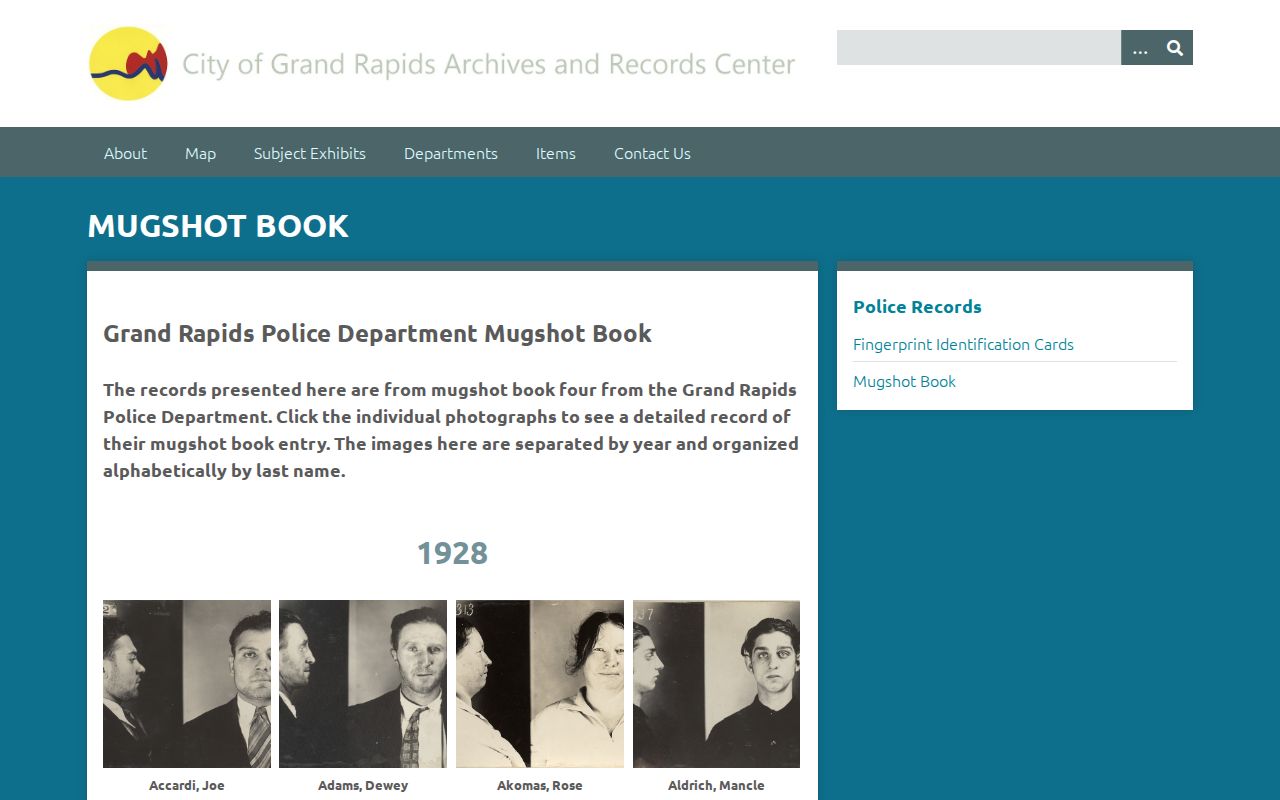
Old Grand Rapids busted mugshots live in a surprising place. The City Archives Mug Shot Book exhibit offers digitized GRPD mugshot books, sorted by year and by name. Entries reach back to at least 1928. Because it points to a real local archival record, not a generic online index, it makes a strong starting point for the city's past.
Keep the time frame straight. A historical book is not a live KCCF roster or a current arrest record. It says nothing about present custody. Treat archival entries as history, not recent-arrest results. Today's questions still start with KCCF, while older police material may mean calling GRPD, the city archive, or county records, depending on who holds it.
Michigan's retention schedule governs long-term county jail files. A county jail inmate jacket can hold booking cards, mug shots, bonds, warrants, and release records. Retention runs ten years past release, subject to the agency's schedule and any hold. That rule covers paperkeeping only. It promises neither a ten-year KCCF viewer nor automatic transfer of current photos to the city archive.
The City Archives exhibit documents historical Grand Rapids police material.
Grand Rapids Crime Coverage
Local newsrooms do much of the day-to-day arrest coverage in Grand Rapids. FOX 17, WZZM 13, WOOD TV8, and MLive / Grand Rapids Press report on arrests, charges, court dates, and public-safety incidents around Kent County. Their photos depend on the story: a crime scene, officials at a podium, agency vehicles, surveillance or body-camera frames, or an image handed over by police. None runs a continuous, official Kent County booking-photo gallery.
When a story catches your eye, trace the original agency statement first. Then check KCCF, GRPD Records, and the right court. That keeps the news report, the booking record, and the legal outcome from blurring together. For a countywide view of these sources, see Crime News & Mugshots.